Brain health is essential at every age. Throughout life, brain health refers to the ability to think, learn, remember, control balance, interpret, and respond to emotions and external stimuli.
Research supports the link between eating certain foods and brain health.
With the aging population, preventing or slowing cognitive decline has become a global public health priority. Dementia, including Alzheimer’s disease, is a leading cause of disability and death worldwide, and even normal aging can bring about declines in memory, processing speed, and executive functioning. Nutrition is increasingly recognized as a key modifiable factor in maintaining brain health across the lifespan.
This article explores the role of avocados—an emerging food of interest in brain health research—within the broader context of dietary patterns, bioactive compounds, and mechanisms relevant to cognition.
Dietary Patterns and Cognition
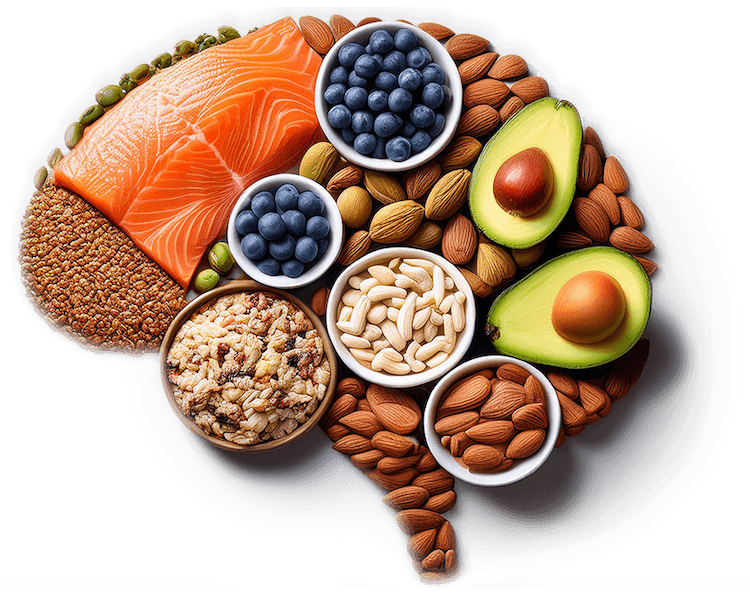
According to the National Institutes of Health, adherence to the Mediterranean diet, which is high in vegetables, whole grains, fish, nuts, legumes, and olive oil, as well as reduced consumption of red meat and alcohol, may correlate with improved cognitive function1. This eating pattern contains more fruits, seafood, and less dairy than the Healthy U.S.-Style Eating Pattern.
Other dietary approaches, such as the DASH diet (Dietary Approaches to Stop Hypertension) and the MIND diet (a hybrid of Mediterranean and DASH), have also been linked with slower cognitive decline, reduced risk of Alzheimer’s disease, and improved structural and functional brain outcomes2,3. These diets share common features: they emphasize nutrient-dense foods, unsaturated fatty acids, antioxidant-rich fruits and vegetables, and fiber, while limiting saturated fat and added sugars.
Whole Foods, Bioactive Compounds, and Phytonutrients
Whole vegetables and fruits are rich sources of bioactives or phytonutrients, including antioxidants, substances found in particular plants, which may promote good health. Antioxidants — such as vitamins C, E, and lutein — help protect the brain from damage caused by free radicals.
Combinations of nutrients, often provided by whole foods, rather than isolated nutrients alone, may play an important role in supporting brain health.
Research Shows Avocados May Support Cognition
Emerging research supported by the Avocado Nutrition Center explores the relationship between eating fresh avocado and brain health benefits. Conclusions cannot be drawn from a single study or generalized to all populations. Observational data does not show cause and effect.
- In a clinical study4 of 40 healthy, older adults, researchers found that people who consumed one avocado per day for six months had higher blood and eye lutein levels compared to when they started the study. Both the avocado and control groups showed improvements in overall memory and the ability to recall and manipulate spatial information. Avocado consumption was linked to a significant improvement in a person’s ability to maintain sustained attention (the ability to stay focused on a task). And, an increase in eye lutein, a non-invasive marker for brain lutein levels, was directly associated with enhanced working memory and improved cognitive efficiency in problem-solving. in. . The Avocado Nutrition Center funded the study. Conclusions drawn from a single study cannot be generalized to all populations, yet this research highlights how the nutrients in avocados—especially lutein—may support both eye and brain health. Improvements in working memory and problem-solving efficiency suggest that avocados could play a role in helping us stay sharp as we age.
- A clinical study5 found that 84 adults with overweight or obesity performed better on a cognitive test when eating fresh avocado daily for 12 weeks. Attentional inhibition, measured by the Flanker task, increased, but other cognitive measures were not changed. The results add to a growing body of research suggesting that avocados could support attention and concentration—necessary for getting your work done and staying focused.
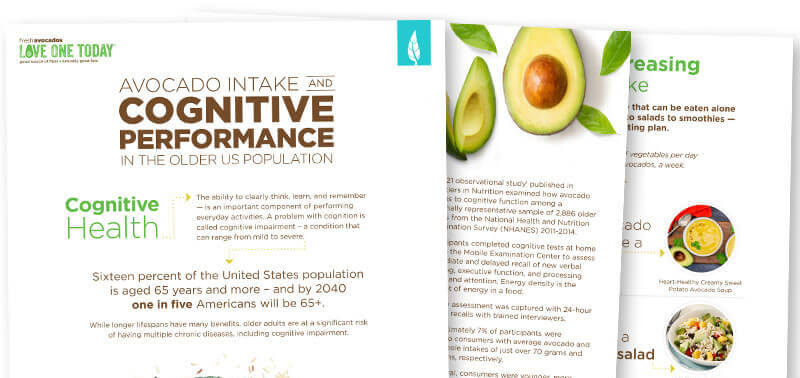
- An observational study6 of over 2800 older adults found that people who eat about 50 grams of guacamole or 70 grams of fresh avocado daily showed better performance on tests that measured short and long-term memory, general thinking, and memory skills compared to non-consumers. The study is based on NHANES survey data using 24-hour dietary recalls. The data suggests a role for avocados in cognitive health.
Together, these studies suggest that avocado consumption may influence cognitive outcomes such as memory, problem-solving, and attentional control—though longer-term and more representative research is needed to confirm causality.
Nutrient Contributions of Avocados to Brain Health
The avocado’s nutrient profile makes it well-suited to support brain health:
- Unsaturated Fatty Acids
Avocados contribute good fats to the diet, providing 5 grams of monounsaturated fat and 1 gram of polyunsaturated fat per 50-gram serving. These fats are integral for normal brain cell development. - Antioxidants
Antioxidants — such as vitamins C, E, and lutein — help protect the brain from damage caused by free radicals. Avocados contain 4% of the DV for vitamin C, 6% of the DV for vitamin E, and 136 micrograms of lutein per serving. - Cardiovascular Benefits
Because cardiovascular and cerebrovascular health are closely linked, avocados’ heart-healthy effects may extend to the brain. Evidence suggests that avocado intake may reduce LDL cholesterol7,8 and improve vascular function9,10, thereby supporting blood flow to the brain.
Preventing Cognitive Decline: The Role of Lifestyle
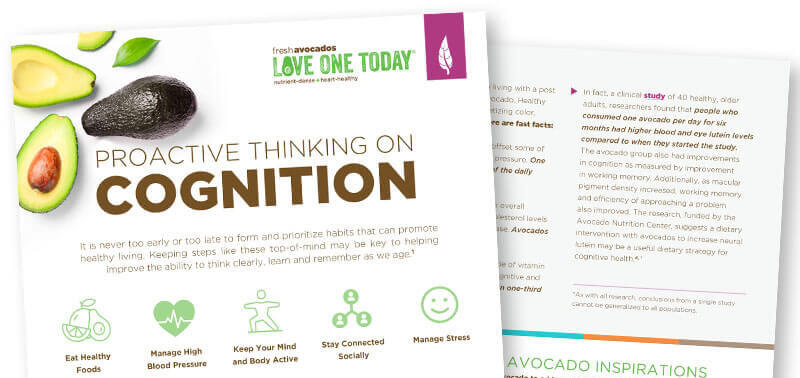
The National Institute on Aging emphasizes modifiable lifestyle factors for preserving cognition that can be shared with your clients:
- Eat a balanced, nutrient-dense diet rich in fruits and vegetables, whole grains with limited solid fats, sugar, and salt.
- Engage in regular physical activity.
- Practice cognitive training and keep the mind engaged.
- Strengthen social engagement & connections.
- Address physical and mental health problems.
Avocados, as part of broader healthy lifestyle patterns, offer patients a practical way to increase their intake of bioactive compounds and beneficial fats, which may contribute to brain health.
Conclusion
Nutrition plays an essential role in developing healthy brain function and protecting it throughout the lifespan. Dietary patterns such as the Mediterranean, DASH, and MIND diets are consistently associated with slower decline.
Avocados contribute unique nutrients—monounsaturated fats, lutein, vitamins C and E—that may support memory, attention, and problem-solving capacity. Early clinical and observational studies, including those funded by the Avocado Nutrition Center, suggest that avocados may have specific benefits for cognition. However, larger and longer-term trials are still warranted.
For health professionals counseling patients, recommending avocados as part of a balanced, brain-healthy dietary pattern represents a simple, evidence-based step toward supporting lifelong cognitive function.