Study Overview
Published: Current Developments in Nutrition
Category: Cardiovascular Health, Healthy Living at Every Age, Type 2 Diabetes
View Published Study
Download PDF

Background:
Few clinical trials have evaluated diet quality change as a predictor of intervention effectiveness.
Objective:
The aim was to examine changes in the Healthy Eating Index-2015 (HEI-2015) following a food-based intervention, and assess the associations between HEI-2015 change and intervention effects on cardiometabolic risk-related outcomes.
Methods:
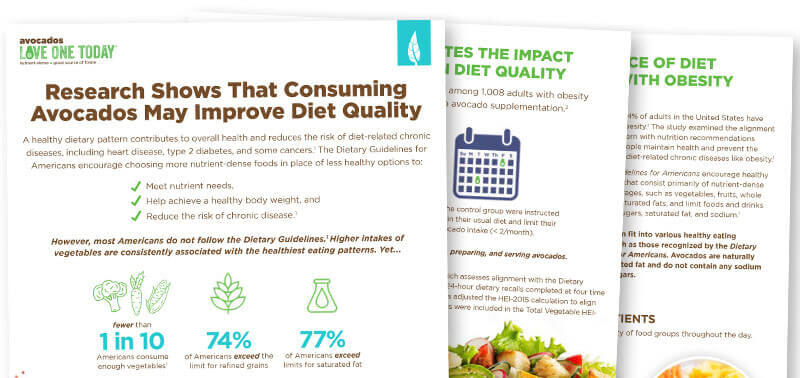
The Habitual Diet and Avocado Trial was a 26-week, multicenter, randomized, controlled parallel-arm study. Participants were 1008 individuals aged ≥25 years with abdominal obesity (women≥35 inches; men≥40 inches). The Avocado Supplemented Diet Group was provided one avocado per day, and the Habitual Diet Group maintained their usual diet. Change in diet quality was assessed using the HEI-2015 from a single 24-hour recall conducted at 4 timepoints. Mixed models were used for analysis.
Results:
The Avocado Supplemented Diet Group had a greater increase in the HEI-2015 (4.74 points; 95%CI 2.93, 6.55) at 26-weeks compared to the Habitual Diet Group. Compared to the Habitual Diet Group, the Avocado Supplemented Diet Group had greater increases in the following HEI-2015 components from baseline: Total Vegetables (0.99 points; 95%CI 0.77, 1.21), Fatty Acid Ratio (2.25 points; 95%CI 1.74, 2.77), Sodium (1.03 points; 95%CI 0.52, 1.55), Refined Grains (0.82 points; 95%CI 0.32, 1.31), and Added Sugars (0.84 points; 95%CI 0.49, 1.19). No difference in HEI-2015 improvements were observed by race, ethnicity, study site, BMI or age category. In the Avocado Supplemented Diet vs. the Habitual Diet Group, the HEI-2015 was increased in women (6.50 points; 95%CI 4.39, 8.62), but not men (0.02 points; 95%CI -3.44, 3.48). Median HEI-2015 change was not associated with intervention-related changes in cardiometabolic risk factors.
Conclusions:
Intake of one avocado per day for 26-weeks in adults with abdominal obesity increased adherence to the Dietary Guidelines for Americans. Changes in diet quality did not predict changes in risk factors for cardiometabolic disease.
Trial Registration:
Clinicaltrials.gov identifier NCT03528031 (https://clinicaltrials.gov/study/NCT03528031)